The nurse who held your grandmother's hand when she died wasn't replaceable. Neither was the lawyer who read your boss's face during the deposition and knew exactly when to stop talking. Or the designer who looked at 40 AI-generated logos and said "none of these, they all feel like they were made by someone who's never been embarrassed before." Jobs AI can't replace aren't mythical. They're right in front of you, and they're yours if you stop pretending they don't count.
The panic about AI and jobs is real, but it's pointed at the wrong thing. What's actually happening is that AI is eating the repetitive, the predictable, and the easily documented. What it's leaving behind, what it genuinely cannot do, is more valuable than most people give themselves credit for.
Here's the honest version.
What does it actually mean for a job to be "AI-proof"?
Nothing is completely immune. If your job is 100% documentation, 100% pattern-matching, and 100% done over email, you've got a problem. But almost no job is that. Most jobs are a mix of things: some of it boring and automatable, some of it deeply human and not.
The World Economic Forum's 2025 Future of Jobs Report makes this clear. It projects 85 million jobs displaced by automation and 97 million new ones created, and the roles growing fastest are the ones requiring human judgment, empathy, and physical dexterity. Not coding. Not "prompt engineering." Judgment. The stuff you're already doing.
So when we say "jobs AI can't replace," we don't mean jobs that are 100% robot-proof forever. We mean jobs where the core value, the thing clients pay for, managers depend on, and customers remember, is something AI consistently fails at. And right now, that list is longer than the LinkedIn doomers want you to believe.
Jobs AI can't replace: the categories that hold up
Let's be specific. There are five categories where human workers consistently beat AI, not because of some sentimental attachment to humans, but because the tasks actually require something the technology can't do.
Empathy-driven roles. Social work, nursing, therapy, counseling, hospice care, special education. The entire value proposition here is human presence. You can't automate grief. You can't automate the thing that happens when someone who has lost a child sits across from another person who actually sees them. Research from Harvard Medical School has documented the measurable clinical outcomes of human presence in care settings. An AI can generate a technically correct care plan. It cannot hold a hand.
Physical and unpredictable environments. Electricians, plumbers, surgeons, carpenters, emergency responders. Robots are genuinely impressive in controlled factory settings. They are terrible in your leaking basement at 11pm. The physical world is messy, contextual, and full of exceptions. The plumber who shows up and says "this isn't what I expected, we need to change the plan" is exercising judgment AI cannot replicate.
Creative direction and taste. Not "can AI make art" (it can, sort of). The question is whether AI can tell the difference between the good version and the bad version. It can't, not reliably. Someone still has to call that. Rule #8 in Don't Replace Me puts it plainly: "AI can generate ten thousand versions of the wrong thing. You still need someone who knows which one is worth keeping."
Moral reasoning under pressure. Judges, ethics boards, doctors making triage decisions, executives deciding whether to blow the whistle. These aren't just hard problems. They're problems where accountability, lived experience, and the weight of consequences matter to the outcome. AI can surface options. It cannot own a decision.
Trust-based relationships. The financial advisor your family has used for 20 years. The lawyer who knows your company's history. The account manager who's navigated three crises with your client. These aren't just relationships. They're institutional knowledge plus trust plus history, and they're extremely hard to replicate.
Why taste is the most underrated human advantage
Everyone talks about empathy and physical work. Fewer people talk about taste, probably because it sounds soft and hard to put on a resume.
But taste is a professional superpower. It's the accumulated judgment of everything you've ever seen, read, experienced, and cringed at. It's what makes a senior editor immediately know that a headline is wrong before they can explain why. It's what makes a good architect know that the technically correct solution is going to feel wrong to live in.
AI generates. It does not evaluate. It can produce a thousand options and has no idea which one is actually right for your audience, your brand, your moment, your client who said they wanted "modern" but actually meant "safe." You know that. You've worked with that client for two years.
This is why creative professionals aren't as replaceable as everyone thought. The threat isn't "AI makes the thing." The threat is "AI makes the thing and you don't add judgment on top of it." The people who stay employed are the ones who sit in what the book calls the director's chair: letting the machine generate, and then actually deciding.
Think about what taste looks like in non-obvious professions. A finance director reviews an AI-generated quarterly report and immediately flags that the tone is too confident given what the team knows about Q4. A senior HR manager looks at an AI-drafted job description and spots that the language will put off exactly the candidates they want. A product manager reads an AI summary of user research and notices it's technically accurate but missing the thing three different users kept circling back to in slightly different words.
None of those catches are in the data. All of them required someone who knew what "right" looks like for that specific context. That's taste. And it compounds with experience in a way that AI can't replicate, because AI doesn't accumulate judgment the way a person does.
If you want to think harder about where your own role falls on the automation risk spectrum, this breakdown of what jobs AI will actually replace is worth reading before you spiral.
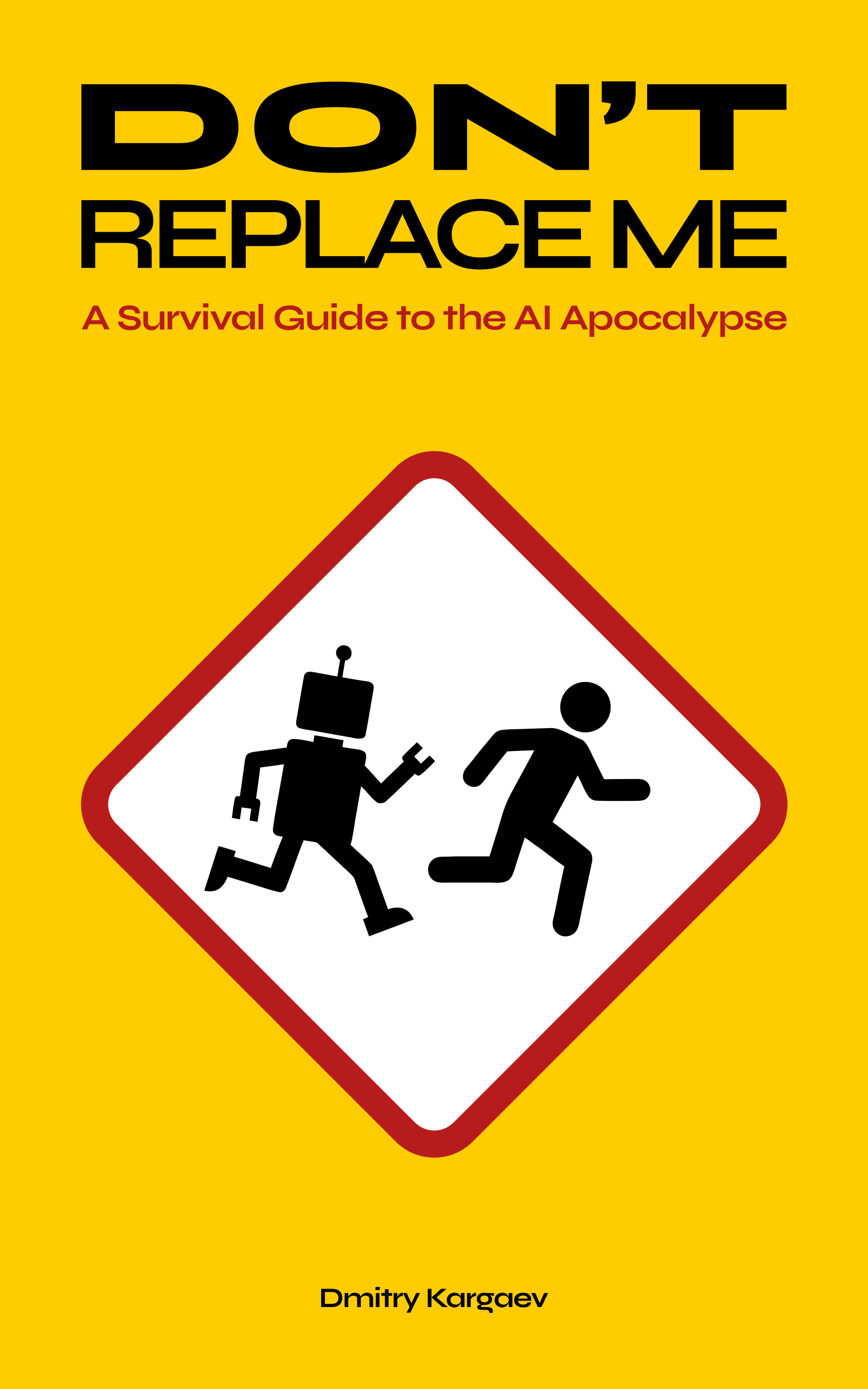
This came from a book.
Don't Replace Me
200+ pages. 24 chapters. The honest version of what AI means for your career, written by someone who actually builds this stuff.
Get the Book →The "it knows everything, it understands nothing" problem
Here's a thing AI genuinely cannot do: understand context that wasn't written down.
Your company has a difficult stakeholder. Everyone who's been there more than six months knows it. Nobody wrote it in any document. It lives in institutional memory, in the raised eyebrow at a certain name in a meeting, in the way the team automatically reframes proposals before sending them to that person.
AI has access to your documents. It doesn't have access to that. It can't read the room. It can't notice that the client seemed distracted today and maybe this isn't the moment to push. It can't feel the political temperature in a reorganization.
A 2024 study from Anthropic examining Claude's reasoning capabilities found that large language models still struggle significantly with novel contextual reasoning, the kind that requires understanding implicit social dynamics rather than stated facts. This isn't a bug that gets patched. It's a fundamental gap between pattern-matching on text and actually understanding how humans operate.
That gap is your job security. And it shows up in places people don't always think about. A consultant who's worked with a client for three years knows which recommendations will die in committee before they're even presented. A sales rep knows that a particular procurement manager always asks about implementation timelines because a previous vendor burned them, even though it's not in any CRM note. A project manager knows which team member goes quiet when they're overwhelmed rather than when they're fine. None of that lives in a database. All of it changes how you do your job.
Physical reality is still a human domain
Automation has made incredible progress in controlled environments: manufacturing lines, warehouse robotics, sorting systems. But the physical world outside of those controlled environments is still largely a human domain.
The Bureau of Labor Statistics projects that roles like home health aides, nurse practitioners, physical therapists, and electricians are among the fastest-growing occupations through 2032. These roles share a common trait: they require real-time physical problem-solving in environments that are never exactly the same twice.
An AI can diagnose from an image. It cannot thread a catheter through a nervous patient who just flinched. A robot can map a floor plan. It cannot figure out that the walls in this specific 1960s house aren't where they're supposed to be and adapt on the fly. The tactile, the spatial, the improvised, all of that is still deeply human.
And before anyone says "but robots are getting better at physical tasks," yes they are. But the cost, the reliability in uncontrolled environments, and the regulatory and liability frameworks around deploying them for complex physical care work? Those barriers are significant, and they don't disappear by 2030. You've got runway.
Consider what it actually takes to fully automate an electrician. You need a robot that can fit into a crawl space, identify which of three dozen unlabeled wires is live, make a judgment call about whether the existing panel can handle the load, explain to the homeowner why the job is going to cost more than estimated, and then deal with the fact that the crawl space is smaller than the blueprints said. That's before lunch. The gap between "AI is impressive" and "AI replaces the trades" is wide and full of liability, physics, and humans who flinch.
More examples of jobs AI can't replace in practice
It helps to get concrete. So here's a table of roles that consistently hold up, and specifically why.
| Role | Why AI can't replace it |
|---|---|
| Therapist | Presence, genuine attunement, the therapeutic relationship itself |
| Emergency room nurse | Real-time physical assessment in chaotic, unpredictable conditions |
| Trial lawyer | Reading the room, improvising under pressure, jury psychology |
| Art director | Taste, knowing what's right for a specific brand voice and moment |
| Elementary school teacher | Emotional attunement to 25 different kids at once, behavioral reading |
| Electrician | Physical improvisation in uncontrolled environments |
| Hospice worker | Human presence during dying, family support, grief |
| Senior account manager | Relationship history, institutional knowledge, trust |
| Surgeon | Fine motor judgment in live situations, adaptive decision-making |
| Whistleblower | Moral courage. AI literally cannot own consequences |
None of these are "low-skill" jobs. Most of them are underpaid relative to their actual complexity. And all of them require something that doesn't exist in training data.
What happens when you combine human skills with AI tools
Here's the uncomfortable nuance. The jobs that are safest aren't just the ones with irreplaceable human skills. They're the ones held by people who have irreplaceable human skills and also use AI well.
A therapist who uses AI to handle their notes, scheduling, and intake paperwork has more time for actual sessions. A creative director who uses AI to generate rough concepts can evaluate 40 options in the time it used to take to generate four. A surgeon who's trained on AI-assisted imaging catches things earlier.
The "taste moat" gets deeper when you can produce more to evaluate. The empathy advantage gets sharper when the administrative noise disappears. Your human edge compounds when you stop spending it on the parts of the job that were always mechanical.
This is the thing most people miss in the "AI replaces jobs" conversation. It's not a binary. It's not you or the machine. It's what you can do when the machine handles your least interesting 40%. If you want a framework for actually starting that process, this guide on using AI at work is the practical starting point.
The combination nobody can copy
Your actual job security isn't one skill. It's a combination: your domain expertise, your specific relationships, your institutional knowledge, and now your AI fluency. That combination is yours. It's not on any training dataset.
Think about it this way. An AI can write a legal brief. It cannot walk into your client's office with 12 years of their company's history in its head and say "I know this feels like a big decision but here's why I think we push, and I also know you have a board meeting Thursday so let's make sure you're comfortable before then." That sentence required domain expertise, relationship history, political awareness, and judgment about timing. Five things at once. All human.
The people who get replaced are the ones who only do one thing, and that one thing is now done by a $20/month subscription. The people who stay are the ones who do several things at once, and who've started using the subscription to do it better.
Your combination is your moat. Domain expertise plus relationships plus institutional knowledge plus AI fluency. None of those individually is enough. All four together is hard to replicate.
The version of this that catches people off guard is how fast the combination becomes specific to you. Two years of using AI to assist with your particular client base, in your particular industry, with your particular institutional history, produces a workflow and a judgment that nobody else has. It's not transferable. It's not replicable. And it gets more valuable the longer you build it.
If you want to build that combination deliberately, the career future-proofing guide lays out the framework.
Which chapters in the book cover this?
If this article resonated, the book goes much deeper on all of it:
- Chapter 7 (You Have Taste) / Rule #8 covers why creative judgment is irreplaceable and how to stop underselling yours.
- Chapter 8 (Nobody Sends a Robot to a Funeral) / Rule #9 is about empathy-driven work and why presence matters in ways that can't be automated.
- Chapter 9 (It Forgets Everything by Morning) / Rule #10 covers the gap between AI "knowing" and actually understanding, with specific implications for your role.
- Chapter 10 (Sit in the Director's Chair) / Rule #11 is the practical one: how to position yourself as the person making calls, not the person executing them.
This page is one chapter's worth of insight. The book has 22 chapters, and they get into the specifics of your actual job in ways a single article can't. Get the full field guide here.
Frequently asked questions
What jobs can AI not replace?
Jobs requiring empathy, physical dexterity in unpredictable environments, creative judgment, moral reasoning, and trust-based relationships are hardest for AI to replace. Roles like therapists, nurses, electricians, surgeons, creative directors, and senior advisors consistently show resilience. The WEF's 2025 Future of Jobs Report projects 97 million new roles emerging that prioritize exactly these human skills.
Will AI ever be able to replace human empathy?
Not in any meaningful professional sense, at least not within the timelines most people are worried about. AI can simulate empathetic language, but it can't provide presence, can't actually understand lived experience, and can't carry the weight of genuine accountability. Research from Harvard Medical School shows measurable clinical differences when human care providers are present versus absent, outcomes AI-generated responses can't replicate.
Are creative jobs safe from AI?
The honest answer is: it depends on which part of the creative job you're talking about. AI is good at generating volume. It's bad at taste, judgment, and knowing which version is right for a specific context. Creative professionals who act as directors rather than executors are in a strong position. The ones at risk are those doing pure production work with no evaluative role.
What human skills does AI struggle with most?
Reading implicit social dynamics, exercising taste and aesthetic judgment, building and maintaining trust over time, reasoning morally under pressure with real accountability, and operating in physical environments that are unpredictable. A 2024 Anthropic study found that even advanced language models struggle significantly with contextual reasoning that requires understanding unspoken social dynamics.
Should I try to become an "AI expert" to stay employed?
You don't need to become an expert. You need to become a user. There's a big difference. Starting with ChatGPT or Claude for 30 minutes a day on the tasks you find most tedious is enough to build real fluency over a few months. The goal isn't to understand how the technology works. It's to know what it can do well enough to hand it the right tasks and evaluate what comes back. This guide on the real AI skills non-technical people need breaks it down by profession.
Is it possible that AI replaces my whole job, not just tasks?
Possible in theory, rare in practice. Most jobs are bundles of tasks, and the tasks that AI replaces are usually not the core value the job provides. The jobs most at risk are narrow, highly repetitive, well-documented roles with minimal human interaction. If your job requires judgment, relationships, or physical presence in any significant way, you're looking at partial automation, not elimination. This breakdown of what jobs AI will actually replace gives a more specific read by industry.