In 1770, a chess-playing robot toured Europe and beat everyone it faced. Royalty. Grandmasters. Benjamin Franklin. The machine was called The Turk, and it caused a sensation for 84 years before anyone admitted the truth: there was a human chess master folded up inside the cabinet, moving the pieces.
The lesson isn't that people were gullible. The lesson is that "looks like intelligence" and "is intelligence" are two completely different things. We've been confusing them ever since.
What AI can and can't do is the question everyone's actually asking when they panic about their job. The honest answer isn't scary or reassuring. It's just useful. So here it is, in plain English, no jargon, five minutes.
What AI actually is (and no, it's not a brain)
The most accurate description anyone has come up with is "spicy autocomplete." That's it. That's the whole thing.
When you type a message and your phone suggests the next word, that's autocomplete. AI does the same thing, but at a scale that makes it look like magic. It's been trained on an incomprehensible amount of text, images, and data. So when you ask it a question, it doesn't "think" about the answer. It predicts, at a statistical level, what words should come next given everything it's seen before.
No reasoning. No understanding. No awareness that it exists. Just very, very fast pattern matching.
Amazon even named a product after this illusion. Amazon Mechanical Turk, their crowdsourcing platform, is named after the 18th-century chess robot. Humans do tasks that are labeled as "AI." The name is basically a confession: sometimes what looks like a machine is just a person hiding inside.
Modern AI isn't hiding a person. But it is hiding the fact that there's no understanding happening either.
What AI can and can't do, part one: what it's genuinely good at
This is where people undersell the tools, because they're too busy either worshipping them or dismissing them.
AI is fast. Faster than any human at the tasks it can handle. Give it a 50-page report and ask for a summary. It'll do it in seconds. Give a human the same job, they'll do it in 45 minutes and still miss two things on page 31.
Here's what AI does well:
- Speed and volume. Processing more text, data, or requests in a minute than a team could handle in a day.
- First drafts. A blank page is the enemy. AI kills the blank page. The draft is bad. Edit it. You're still ahead.
- Pattern recognition. Spotting trends in data, flagging anomalies, finding the thing that doesn't fit.
- Summarization. Long document, short summary. Every time.
- Translation. Not perfect, but good enough for most professional contexts.
- Repetitive generation. Writing 200 product descriptions, 50 subject line variants, 30 meeting agendas. The stuff that was boring and slow before.
The key word in all of these is "fast." AI isn't better than you at creative judgment, nuanced communication, or genuine problem-solving. It's just faster at the mechanical parts of those tasks.
It's also worth being specific about the gap. A McKinsey report on AI and the future of work found that generative AI could automate tasks accounting for 60 to 70% of employee time across industries. That's not 60 to 70% of jobs. That's the fraction of time within most jobs that's spent on mechanical, repeatable work. The rest stays human.
If you want to understand which specific tasks to hand off first, the no-BS starter guide to using AI at work walks through exactly that.
What AI can and can't do, part two: the hard limits
Here's Rule #10 from Don't Replace Me: "It knows everything. It understands nothing."
That sentence is doing a lot of work. Here's what it means in practice.
It can't tell when it's wrong. This is the big one. AI doesn't know what it doesn't know. If you ask it a question it doesn't have good data for, it will still answer confidently, in complete sentences, with the same tone it uses when it's absolutely right. The word for this is "hallucination." The problem is you can't always tell which answers are real and which are confabulated. You have to check. That's a human job.
It doesn't understand meaning. Dee spent a session telling an AI "you are absolutely right" six times in a row. It kept agreeing and kept missing the point. That's not stupidity. It's the absence of comprehension. The system processes tokens. It doesn't know what the words mean in any real sense. It doesn't know that your email to your CEO needs a different tone than your email to your intern. It doesn't know that the joke you're about to send will land badly with this particular client. You know those things. It doesn't.
It can't exercise judgment. Judgment means deciding between options when there's no clear right answer. When your boss asks you to prioritize two projects and both matter, you read the room, you think about politics, you weigh relationships. AI can give you a framework. It cannot make the call.
It doesn't care about outcomes. This sounds philosophical, but it's practical. You care whether your client is satisfied. You care whether your team is burning out. You care whether the presentation lands. AI produces output. What happens next is not its problem.
It can't read a room. Physical presence, group dynamics, the moment when the meeting energy shifts, the colleague who's technically agreeing but whose face says something else. None of this is accessible to a language model. And a lot of actual work depends on exactly this.
It has no taste. Taste is knowing what's good before you can explain why. It's the thing that separates a good editor from a grammar checker. AI can follow rules. It can't develop taste, because taste comes from years of experience, failure, and caring about the outcome.
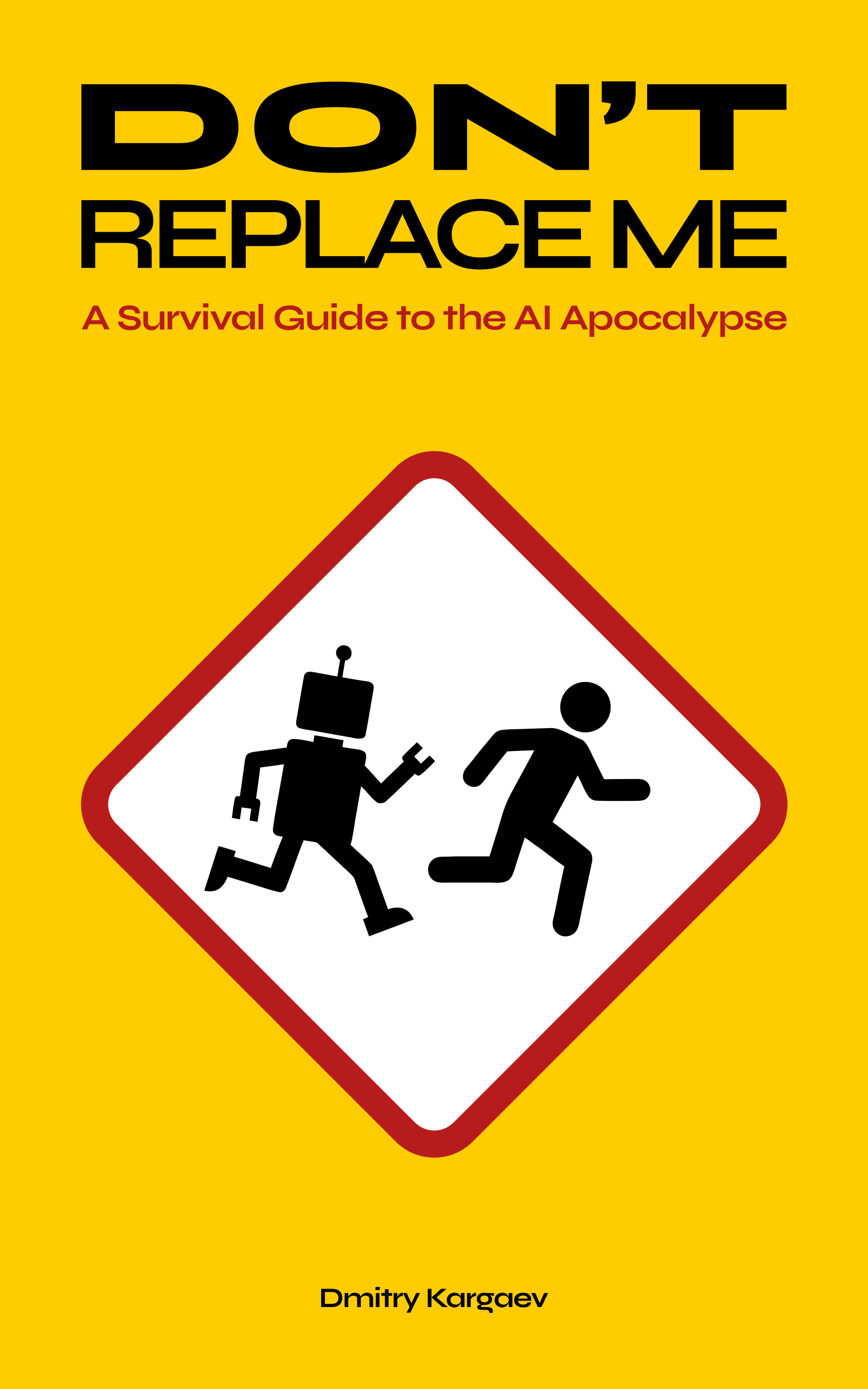
This came from a book.
Don't Replace Me
200+ pages. 24 chapters. The honest version of what AI means for your career, written by someone who actually builds this stuff.
Get the Book →A quick reference: what AI handles vs.what it doesn't
The split isn't random. There's a pattern. Tasks that are well-defined, text-based, and repetitive tend to go to AI. Tasks that require judgment, context, or human relationships tend to stay human.
| AI handles well | Humans still own |
|---|---|
| Summarizing long documents | Deciding what the summary means |
| Drafting routine emails | Knowing when the email shouldn't be sent |
| Generating data reports | Judging which data actually matters |
| Producing first drafts | Knowing when a draft is wrong in ways a spell-check won't catch |
| Spotting patterns in data | Understanding why the pattern exists |
| Translation and localization | Reading the cultural subtext |
| Repetitive content at scale | Making anything that requires genuine taste |
The dividing line is basically: can you write a complete instruction manual for this task? If yes, AI can probably do it. If the task requires improvisation, relationship awareness, or accumulated judgment, it can't. Not yet, and not in any timeline that's clear.
Why this distinction actually matters for your specific job
Here's the thing nobody says in the LinkedIn posts: AI being bad at these things is good news for you.
If your job is purely mechanical, repetitive, and output-based, yes, worry. Some of those jobs are going. But most jobs aren't that. Most jobs involve a mix: some mechanical parts (the stuff AI is fast at), and some human parts (the stuff AI can't touch).
The people who are actually at risk are the ones who refuse to use AI for the mechanical parts, because they end up slower than the person next to them who does use it. The threat isn't robots replacing humans. It's humans using AI replacing humans who don't.
Think about what a mid-level marketing manager actually does in a week. They write briefs. They sit in strategy meetings. They review agency work. They manage up. They manage down. They send a lot of emails. They occasionally fight for budget. AI can help with the briefs and the emails. It cannot sit in the strategy meeting and notice that the CMO's energy completely changed when the Q3 numbers came up. It cannot fight for budget. It cannot manage the relationship with the agency contact who's difficult but brilliant. The mechanical tasks shrink. The human tasks remain, and they become more visible because you have more time for them.
The practical move is simple: figure out which parts of your job are mechanical and which parts are human. Hand the mechanical parts to AI. Put more of your time into the human parts. You get faster at the boring stuff, you get better at the valuable stuff, and you become harder to replace.
If you want to know which specific skills are genuinely hard for AI to replicate, the breakdown of jobs AI can't replace gets specific by role and industry.
The visibility problem (why this feels new when it isn't)
You've been using AI for years. Spam filters are AI. Autocorrect is AI. Netflix recommendations are AI. Google search ranking is AI. Your bank's fraud detection is AI.
None of those things caused a mass panic. Why is this different?
Because ChatGPT put a text box in front of you and started generating complete sentences. That made the AI visible in a way it wasn't before. You weren't scared of the spam filter because you never had to talk to it. When the AI talks back in paragraphs, it feels like a person. It isn't. But it feels like one.
The panic isn't about what changed. It's about what became visible. The tools got better, yes, and some jobs really are at risk. But the hysteria is bigger than the actual threat, because the actual threat is nuanced and nuance doesn't trend on LinkedIn.
The World Economic Forum's Future of Jobs Report projects that AI will displace 85 million jobs by 2030 while creating 97 million new ones. That net positive number gets buried under every headline about what's being lost. Understanding what the job replacement statistics actually say versus what the headlines say is a decent place to ground yourself if the panic is getting loud.
The confidence problem: why AI sounds so sure when it's wrong
This deserves its own section because it's the thing that catches smart people out.
AI doesn't have a confidence meter. It can't tell you "I'm 90% sure about this" versus "I made this up." It produces output in the same tone regardless of whether the underlying information is solid or completely fabricated. A hallucinated statistic sounds exactly like a real one. A made-up legal citation reads identically to an actual court case. A plausible-sounding product recommendation might be based on nothing at all.
The Stanford HAI research group has documented this pattern extensively: models produce confident, fluent text even when their outputs are factually wrong, internally inconsistent, or simply invented. The problem isn't that AI is wrong sometimes. Every source is wrong sometimes. The problem is that it's wrong with complete confidence and no warning label.
This matters practically. If you're using AI to draft customer communications, legal summaries, financial analyses, or anything where accuracy is load-bearing, you need a human in the loop checking the output. That's not a temporary workaround until AI gets better. It's the correct workflow, because AI's role is generating, and your role is verifying.
The people who get burned are the ones who outsource both steps.
The one-sentence summary
AI is a tool that's fast and tireless at mechanical tasks, completely blind to meaning and judgment, and incapable of caring what happens next. Use it for speed. Keep the parts that require you to be human.
That's it. That's the five minutes.
Frequently asked questions
What does "AI is just spicy autocomplete" mean?
It means AI generates text by predicting what words should come next, based on patterns in its training data. It's not reasoning or understanding. It's a very fast, very large pattern-matching system that produces confident-sounding output even when it's wrong.
Can AI actually think or understand things?
No. AI processes statistical patterns in data. It doesn't understand what words mean, can't form intentions, and has no awareness of its own outputs. It can produce text that sounds thoughtful without any thinking happening. This is why checking AI outputs matters, because it can't tell you when it's wrong.
What can AI do better than humans?
Speed and volume, mostly. AI can summarize documents, generate first drafts, spot patterns in data, translate text, and produce repetitive content much faster than any human. It doesn't get tired, distracted, or bored. For the mechanical parts of most jobs, it's genuinely useful.
What can't AI do?
AI can't exercise judgment, read a room, develop taste, understand meaning, care about outcomes, or know when it's making something up. Any task that requires empathy, political awareness, context sensitivity, or genuine creativity still belongs to humans. See the full breakdown of jobs AI can't replace for role-specific examples.
Will AI replace my job?
Probably not the whole job. Likely some tasks within it. The risk goes up if you refuse to use AI for the mechanical parts of your work, because someone who does use it will be faster than you at those parts. The honest answer, with data, is at will AI replace my job.
Do I need to understand how AI works to use it?
No. You don't know how an internal combustion engine works and you can still drive to the grocery store. The basics help you set appropriate expectations (it can be wrong, it doesn't understand you, check important outputs). Beyond that, just use it and see what it does.