The Goldman Sachs report said 300 million jobs could be "exposed" to AI. That number hit LinkedIn like a grenade. Three hundred million. By the time it reached your feed, "exposed" had become "replaced," and "could be" had become "will be," and suddenly everyone was refreshing their resume at midnight.
Will AI replace your job? Here's the honest answer: probably not in the way you're imagining. But the question itself is the wrong one to be asking.
What "will AI replace my job" actually means
The Goldman Sachs figure everyone quotes comes from a 2023 report on generative AI and labor markets. The word they used was "exposed." As in, some tasks within those jobs could be automated. Not the whole job. Not the person. The tasks.
That's a meaningful distinction, and almost nobody made it.
Your job is a bundle of tasks. Some of those tasks are repetitive, rule-based, and mind-numbing. Those are the ones AI is genuinely good at. The rest, the judgment calls, the relationship management, the reading-the-room moments, the things that require knowing the history of a client or the personality of a boss, those are still yours.
"Exposure" means some of your job got easier, or cheaper, or faster. It doesn't mean you're out.
The headline math never adds up
Let's look at the other numbers people throw around.
The World Economic Forum's Future of Jobs Report 2023 predicts 83 million jobs displaced by 2027, but also 69 million new jobs created. Net loss: 14 million, in a global workforce of over 3.3 billion people. That's 0.4%.
McKinsey's task-level research suggests that less than 5% of jobs can be fully automated with current technology. Fully. As in, every task in the role done by a machine, end to end.
The 300 million number. The "80% of jobs by 2030" you saw on that podcast. The stats feel massive because they're presented without context, without timelines, without any explanation of what "exposure" or "disruption" actually means in practice.
And yes, some jobs will go. Entirely. Some already have. Data entry clerks, certain paralegal functions, image editing tasks that used to take days. This is real. But it's not the apocalypse the headlines sell.
Why the panic is profitable (and not for you)
Every third LinkedIn post says AI is coming for your job. Usually right before someone sells you a course. That's not a coincidence.
Fear is a business model. Scared people buy things. They buy $997 prompt engineering masterclasses. They buy "AI readiness audits." They pay for certifications in tools that will be obsolete in eight months.
The people selling you the panic are the same people selling you the solution. That's a conflict of interest so obvious it's almost funny.
EY research found that 65% of employees report anxiety about AI and job replacement. Sixty-five percent. That's a lot of nervous systems being rented out to headlines that benefit from the click, not from your career outcomes.
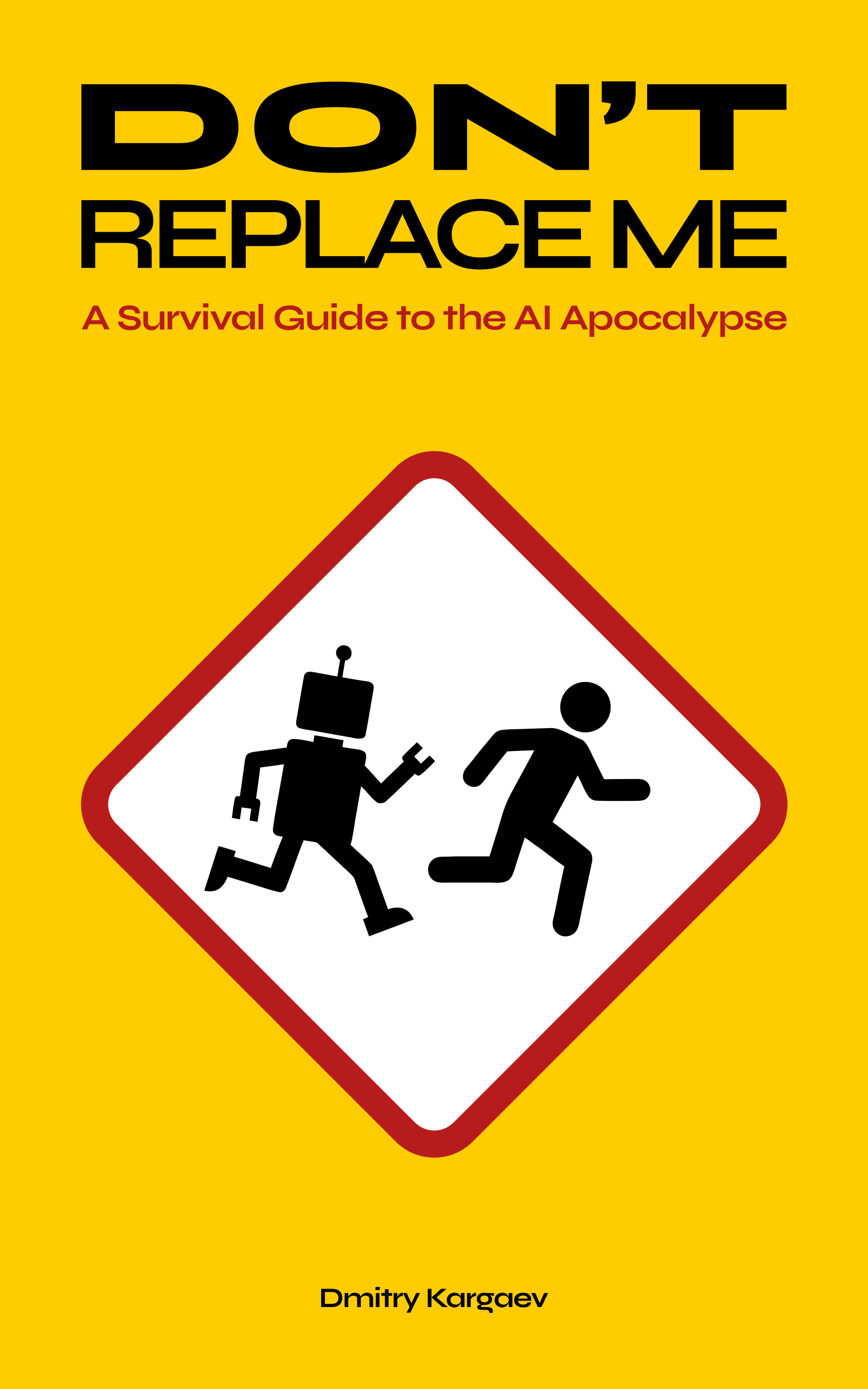
Rule #1 in Don't Replace Me names this directly: "Fear Is a Subscription Model." The headlines make money keeping you scared. Your career gets better when you stop paying that subscription.
This came from a book.
Don't Replace Me
200+ pages. 24 chapters. The honest version of what AI means for your career, written by someone who actually builds this stuff.
Get the Book →What AI is actually doing to jobs right now
Here's what's actually happening, on the ground, in real companies.
AI is making some people faster. Those people are handling more work, in less time, with less effort. In some cases, that means companies hire fewer people for certain roles. In most cases, it means the people using AI look a lot better than the people who aren't.
Most companies are nowhere near replacing whole departments with robots. Most of them still can't update a CRM without starting a small fire. The gap between "AI can do this in a demo" and "AI does this reliably in our actual tech stack" is enormous, and anyone who works inside a real organization knows it.
What is changing is the baseline. If you're a writer who takes three hours to draft a client report, and your colleague uses AI to draft one in 20 minutes that you then spend an hour editing, the math on headcount starts to shift. Not because the machine replaced anyone. Because one person got faster and the other didn't.
That's the real threat. Not a robot with your nameplate. A coworker with a faster workflow.
What "faster" looks like by role
This plays out differently depending on what you do. A junior analyst who used to spend two days pulling market research can now get a decent first pass in two hours. A recruiter who used to screen 200 resumes manually can process them in 20 minutes. An HR coordinator who drafted the same onboarding email 40 times a month has automated it entirely.
None of those people got fired. But their manager noticed. And the next time a budget conversation happens, the headcount math looks different.
The people at risk aren't the ones whose entire jobs are automated. They're the ones whose output looks identical to their AI-assisted colleagues, but takes three times as long. That gap is where the pressure actually lives.
The "find your appendix" test for your own job
There's a useful exercise from Chapter 1 of the book: find your appendix.
Your appendix is the part of your job that's vestigial. You do it. It takes time. But it produces very little that couldn't be produced faster and cheaper by a machine. Think: formatting reports, pulling data into spreadsheets, writing first drafts of standard emails, summarizing meeting notes, researching background information.
That's not your whole job. That's a piece of it. And it's the piece that's genuinely vulnerable.
The rest of your job, the parts that involve trust, judgment, client relationships, institutional knowledge, navigating office politics, making the call when the data is ambiguous, that's the part AI hasn't touched. Check out what jobs AI genuinely can't replace for a longer breakdown on where those human edges actually live.
The practical question isn't "will AI replace me?" It's: "what percentage of my current tasks could be done faster by AI, and am I using AI to do them?"
If you're not, someone else in your field is. And they're getting faster while you're staying still.
How to actually run the audit
Grab a piece of paper. List every task you did last week, roughly. Don't filter, just list them. Then put each one in one of two columns: "requires me specifically" or "requires someone with my general skills."
The second column is your exposure. Not your doom, your exposure. Those are the tasks worth experimenting on first.
If 80% of your week lands in column two, that's important information. It doesn't mean you're getting fired next Tuesday. It means your job is more vulnerable to the baseline shift than you might have assumed, and you should probably start getting faster at the stuff in column one while using AI to compress column two.
Most people who do this exercise are surprised. Not because AI can do everything, but because they've never really looked at how much of their week is genuinely rote.
Will AI replace my job? The honest self-assessment
Here's a rough way to think about your own vulnerability.
| Job characteristic | Lower risk | Higher risk |
|---|---|---|
| Requires physical presence | Yes | No |
| Involves high-stakes judgment | Yes | No |
| Requires reading people | Yes | No |
| Output is mainly text or data | No | Yes |
| Tasks follow predictable rules | No | Yes |
| Client relationships are central | Yes | No |
| Work is largely solo and digital | No | Yes |
No single factor determines anything. This is a texture check, not a verdict. A lawyer who does nothing but document review is in a different position than a litigator who spends 80% of her time in rooms persuading people. A journalist who summarizes press releases is in a different position than an investigative reporter with sources built over 20 years.
Most jobs land somewhere in the middle. Which means most people have some exposure and some protection. The goal is to know which is which for your specific role, in your specific organization, in your specific industry.
For a deeper look at which roles face the most pressure, what jobs AI will actually replace breaks it down by sector with a realistic timeline.
Where the real dividing line is
The honest dividing line isn't "knowledge worker vs.manual worker" or "creative vs. analytical." It's simpler than that.
If your job fundamentally requires other people to trust you specifically, as a person, with a history and a relationship, you're in a much better position than someone whose job just requires that the output meets a spec. AI can meet specs all day. It can't be the specific person your client has worked with for six years who knows their business, their preferences, and their boss's personality.
That's the thing to build toward. Not "AI-proof skills" in the abstract. Irreplaceability through specificity.
The pattern has happened before
In 1811, a group of skilled textile workers in Nottingham started breaking machines. They signed their letters "General Ludd." History turned them into a punchline for anyone afraid of technology.
But they weren't stupid. They were scared, and they were right to be scared. The machines did change their work. Permanently.
What history also shows: most people adapted. The machines stayed. The work changed shape. New jobs appeared that didn't exist before. The telephone killed telegraph operators and created hundreds of thousands of telephone operator jobs. The internet killed travel agents and created social media managers, UX designers, and SEO specialists. The spreadsheet was supposed to eliminate accountants. Instead the number of accountants in the US grew for three decades after Excel shipped.
This pattern doesn't mean you personally will be fine automatically. It means the category of "human worker" has survived every previous technology wave, and it will survive this one too. The individuals who got hurt were mostly the ones who didn't adapt, or who adapted too slowly.
That's the actual risk. Not that AI arrives one day and takes your job like a repo man. But that the field shifts underneath you while you're waiting to see what happens.
Why this wave feels different (and why it isn't, quite)
The reason people feel like this time is different is that AI is hitting knowledge work. Previous automation hit physical or highly repetitive tasks. The loom threatened weavers. The calculator threatened human "computers." But your doctor, your lawyer, your writer, your analyst, those felt safe.
Now they don't. And that's genuinely new, psychologically if not structurally.
But the underlying dynamic is the same. New technology compresses the time required for certain tasks. The people doing only those tasks face pressure. The people whose work goes beyond those tasks adapt and absorb the productivity gain. The economy eventually generates new categories of work, often ones that require the new technology as a baseline.
The difference is that the cycle is moving faster now. Adaptation that used to take a generation might take five years. That's uncomfortable. It's not the end.
For a more thorough look at how to build a position that holds up, how to future-proof your career against AI gets into the specific moves that actually work.
The middle scenario nobody talks about
Here's what the discourse skips. The doomers say robots take everything. The optimists say new jobs will appear and everyone will be fine. Both groups are selling a story.
The actual middle scenario: your job changes significantly, probably within the next three to five years. Some tasks you currently do disappear or become trivially fast. New expectations appear around speed and output. Your value shifts from "can produce X" to "can produce X and Y and also know which AI output is good and which is garbage."
That's a real adjustment. It's not a death sentence. But it does require you to pay attention and move, rather than waiting for clarity that isn't coming.
The people who will struggle most are the ones who treat this period like a waiting room. They're watching the news, reading the think pieces, attending the all-hands where the leadership says "we're monitoring the situation." And they're not changing anything about their actual workflow.
The people doing well right now are the ones who just started using the tools, found out what they're good for, built a slightly faster version of their job, and moved on. No $997 course. No certification. Thirty minutes with ChatGPT and a specific problem.
The real threat isn't a robot. It's a coworker who's been using the tools for eight months while you were still deciding whether to try them.
What to do right now that isn't a $997 course
You don't need a certification. You need 30 minutes and a ChatGPT or Claude account, which you can get for free.
Here's the only thing that matters this week: identify the one task in your job you hate most, the one that's repetitive and draining and you procrastinate on. Then spend 20 minutes asking AI to help you do it.
Not because AI will transform your career in a day. Because you'll immediately understand what the tool can and can't do, without anyone explaining it to you. And that understanding is worth more than any course you could buy.
The book's core framework for this is Rule #12: Start With the Shit You Hate. The idea is that the tasks you hate most are usually the ones most worth automating, and starting there gives you a quick win without disrupting the parts of your job that actually require you.
Once you've done that once, you'll know more about your own vulnerability and your own opportunity than any report or LinkedIn prophet could tell you. Because you'll have specific, concrete information about what AI can do with your actual work, not someone else's demo.
That's the whole move. Not a transformation. A test.
Frequently asked questions
Will AI replace my job completely?
Almost certainly not completely, if your job involves judgment, relationships, or physical presence. The McKinsey research suggests less than 5% of jobs can be fully automated with current technology. What's more likely is that AI replaces specific tasks within your job, changing what the work looks like rather than eliminating the role entirely.
What does "AI exposure" actually mean in the Goldman Sachs report?
It means some tasks within a job could theoretically be done by AI, not that the job disappears. The original report used "exposure" to describe task-level overlap, which headlines quickly inflated to "replacement." A surgeon is "exposed" because AI can analyze scans, not because robots are performing surgeries.
How worried should I actually be about AI taking my job?
Worried enough to start using the tools, not worried enough to buy a $997 course. The real risk isn't mass replacement; it's that people using AI become visibly faster and more productive than those who don't. EY found 65% of workers feel AI anxiety, but the action that actually helps is experimentation, not stress.
What jobs are safest from AI replacement?
Jobs requiring physical presence, high-stakes human judgment, emotional attunement, deep client trust, and navigating complex social or political situations. Care workers, skilled tradespeople, therapists, surgeons, and people who build and maintain relationships are all in structurally safer positions. See jobs AI can't replace for more detail.
Is there a way to assess my own job's vulnerability to AI?
Yes. Make a list of every task you do in a given week, then ask: could a rule-following machine do this if given the right inputs? The tasks that answer "yes" are your appendix. The tasks that answer "no" are your protection. Most jobs have both, which means most people aren't cooked, they just need to know which parts of their work to lean into.
Is the WEF really saying AI will destroy 83 million jobs?
The WEF Future of Jobs Report 2023 projects 83 million job displacements by 2027 alongside 69 million new jobs created, for a net loss of about 14 million in a workforce of billions. It's a real and significant disruption, not a hiring freeze of one. The new jobs angle rarely makes the headline.
How fast is this actually happening?
Faster than previous technology waves, slower than the headlines suggest. Most organizations are still in early experimentation. The WEF projects meaningful disruption by 2027, not tomorrow morning. But "not tomorrow" doesn't mean "not soon." If your field has obvious AI applications and you're not paying attention, three years goes fast.